
Global Undergraduate Awards Spotlight: Sarah Torres Escandon
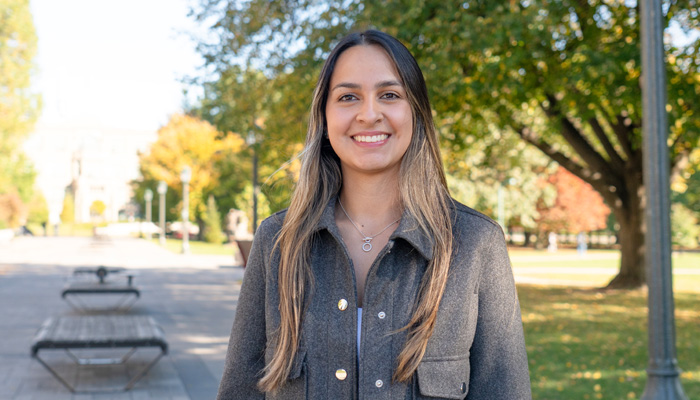
Sarah Torres Escandon
BMSc’26 (Honours Specialization in Physiology & Pharmacology)
Regional Winner: Medical Sciences
Paper title: ATF4 Promotes a Modest Pro-Inflammatory State in Microglia and Partial Astrocyte Reactivity
Please provide a brief summary of your paper/research.
My research investigated how inflammation is regulated in the brain, focusing on communication between microglia and astrocytes, two types of cells that support and protect the nervous system. I specifically studied ATF4, a protein involved in the cellular stress response, to determine whether it could promote inflammation in microglia and influence nearby astrocytes.
I increased ATF4 levels in mouse microglia and examined changes in inflammatory markers. I then exposed astrocytes to signals released by these microglia to assess whether they became reactive. My results showed that ATF4 promoted a modest pro-inflammatory state in microglia and caused some astrocyte reactivity, but was not sufficient to produce the fully harmful astrocyte state associated with neuronal death.
These findings suggest that additional signaling pathways are needed to drive this inflammatory response. Understanding how microglia and astrocytes communicate may provide insight into the mechanisms underlying neurodegenerative diseases such as Alzheimer's and Parkinson's disease.
What led to your interest in this area?
I wanted to gain experience in a wet lab because I really enjoyed the hands-on aspect of my laboratory courses and wanted to see what research was like beyond the structured experiments of undergraduate courses. This project was my fourth-year Honours thesis and was my first time working independently in a research lab, which I found both challenging and exciting.
I was especially drawn to the project because of its real-world implications. I was interested in exploring inflammation in the brain, particularly how it contributes to neurodegenerative diseases and how studying these pathways could eventually help identify new approaches to treatment. Being able to investigate a question with broader implications for human health made the research especially significant to me.
What prompted you to submit your paper to the competition?
I received an email from Western explaining that undergraduate coursework could be submitted to the Global Undergraduate Awards for a chance to have it recognized and attend a conference in Dublin. To be honest, I didn't think much of it at first. I realized that the submission was fairly simple and only involved submitting my already-completed thesis, so I figured, “Why not?” I had nothing to lose, and it seemed like a good opportunity to put my work out there. I definitely didn't expect that it would eventually lead to me being selected as a Regional Winner.
Can you describe how you felt when you found out you'd been selected as a winner?
I was honestly very surprised when I found out. I knew there were thousands of submissions to the Global Undergraduate Awards, so I never expected to be selected as a winner, let alone a Regional Winner. It took me a little while to fully believe it, but it was honestly the best feeling.
It was really meaningful to me to have my work recognized, especially because it was my fourth-year thesis and one of the biggest projects I worked on during my undergraduate degree. It felt like the hours I put into my thesis had come full circle, and like the perfect way to end my undergraduate degree at Western.
What are your plans for the future – do you plan to continue in this field?
For the coming year, I plan to volunteer in a lab at Robarts Research Institute, where I completed my Honours thesis, and contribute however I can using the skills and knowledge I developed through my research. I'm very grateful for the opportunity to have worked with the members of Dr. Cregan's lab and to have gained a unique perspective on what it means to be a researcher. The knowledge and experience I gained throughout my thesis are things I hope to continue building on this year.
Will you be attending the Global Summit in Dublin? If so, what are you most looking forward to there?
Yes, I will be attending! I'm really excited to visit Dublin for the first time and, of course, to attend the Global Summit. I'm especially looking forward to sharing my research with other students, meeting like-minded people from around the world, and learning about the research they are passionate about. I'm also excited to experience something completely new and get a glimpse of Irish culture while I'm there. I think it will be a great opportunity to step outside of my usual academic environment and connect with people and ideas I may not otherwise encounter.
What do you think the benefit of programs like the Undergraduate Awards is for students?
I think programs like the Global Undergraduate Awards offer a unique opportunity for students to have their work recognized beyond their own university. As an undergraduate, most of your work is only seen by your professors, so having the opportunity to have it recognized by a broader community can be really valuable. I also think recognition like this can give students more confidence in their abilities and motivate them to continue pursuing areas of research they are passionate about.
For students who are selected to attend the Global Summit, there is also the opportunity to practice communicating their research to a broader audience. Being able to explain your work to people outside of your usual academic setting is a valuable skill, and I think having that experience as an undergraduate can be rewarding.


